The oil additive shelf at a parts store can run six feet wide, and nearly every bottle on it promises less friction, a quieter engine, or more years of engine life.
Your truck has 140,000 miles on it. It ticks for a few seconds on cold mornings, and you'd like to know which engine oil additive is best for it—or whether any of them will do more than lighten your wallet.
Fair question.
The engine oil additive category has attracted its share of exaggerated claims over the years, including claims that brought enforcement action from federal regulators. That doesn't mean aftermarket oil additives cannot provide useful protection. It means you need to understand what the oil already contains, what problem you are trying to solve, and whether the product you're considering has credible evidence that it can do what it claims.
This guide sorts out what your motor oil already does, what an aftermarket additive can reasonably add to it, and how to tell whether your engine is likely to benefit from one at all.
Which engine oil additive is best for your engine?
Which engine oil additive is best depends on what your engine is short on. An engine running the oil grade its owner's manual calls for already carries a complete additive package, so under normal driving the best additive may be none at all. Heavy load, high mileage, and long periods of sitting are where a supplement earns its cost.
That answer frustrates people who came for a brand name, so here is the practical version: match the additive to the job. An engine burning a quart every 1,000 miles needs something different from a diesel pickup towing a camper over a mountain pass, and both need something different from a farm tractor that sits from October to April.
Bell Performance has worked in fuel chemistry since 1909, and the advice it gives customers is the same advice in this guide. Figure out what the engine needs, then decide whether anything belongs in the crankcase.
What does the additive package in motor oil already do?
Every licensed motor oil is base stock plus an additive package. Detergents keep hot metal surfaces clean, dispersants hold soot and sludge in suspension until the drain, anti-wear agents such as ZDDP (zinc dialkyldithiophosphate) form a protective film on cam lobes and lifters, antioxidants slow thermal breakdown, and an alkaline reserve neutralizes the acids combustion produces.
That reserve is measured as total base number, or TBN, and it drops as the oil ages and the package gets used up. Viscosity modifiers keep the oil thin enough to reach the top of the engine on a cold start and thick enough to hold a film once it's hot. Pour point depressants and anti-foam agents round out most formulas.
The American Petroleum Institute licenses oils that meet these performance standards. The current gasoline engine category is API SQ, which began licensing alongside ILSAC GF-7 on March 31, 2025 (API, via MOTOR). Find the API service symbol on the back label and match it to what your owner's manual specifies.
One correction worth making, because it shows up in a lot of additive marketing: ZDDP is an anti-wear additive, not a friction modifier. It protects parts during boundary lubrication, the moment the oil film gets thin enough for the high spots on two metal surfaces to touch.
Any aftermarket product has to work inside that package. A treatment that fights the detergents or drops out of suspension in the oil pan does more harm than leaving the oil alone.
What are the main types of aftermarket oil additives?
Aftermarket oil additives fall into five families: viscosity stabilizers that thicken oil in worn engines, anti-wear and extreme pressure supplements that reinforce the film under load, seal conditioners for aging seals, engine cleaners used just before a drain, and friction modifiers. Each one fixes a specific problem, and each carries a specific risk.
Additive type
What it does
Best fit
Watch for
Viscosity stabilizer
Thickens oil and slows thinning at temperature
Older engines burning or seeping oil
Can push oil out of the grade your manual calls for and slow cold-start flow
Anti-wear and extreme pressure supplement
Reinforces the oil film where metal meets metal under load
Towing, plowing, heavy equipment, flat-tappet engines
Claims without published test data; suspended solids that are not proven filter-safe
Seal conditioner
Softens and swells aging rubber seals
Slow seeps from old main or valve seals
Will not fix a cracked seal or a failed gasket
Engine cleaner or flush
Loosens sludge so it leaves with the drain
Sludged engines, used right before an oil change
Not for driving on; drain it as directed
Friction modifier
Lowers friction between sliding surfaces
Fuel-economy-focused passenger car oils
Clutch slip in motorcycles with wet clutches
Skepticism about this whole category is earned. In 2000, the Federal Trade Commission settled charges with the marketers of Dura Lube and Motor Up over engine treatment claims the agency described as deceptive and unsubstantiated, and the same announcement listed earlier FTC actions against advertising for several other well-known engine treatments (FTC). Those cases are the reason to ask any brand for its test data before you buy.
How do you know if your engine oil needs more protection?
Start with how the engine is used, not with a symptom you hope an additive will make disappear.
An engine that regularly tows, hauls, operates under sustained high load, sees severe temperatures, has accumulated substantial mileage, or spends long periods in storage may have a stronger case for supplemental lubrication protection than a newer engine driven normally on the oil its manufacturer specifies.
Symptoms can still tell you something, but diagnose them before reaching for a bottle.
A persistent lifter tick, increasing oil consumption, sludge under the oil fill cap, or low oil pressure can indicate a lubrication problem, but each can also point to a mechanical condition that an additive will not correct. Low oil level, worn components, restricted oil passages, fuel or coolant contamination, and an oil that is wrong for the application all need to be considered.
Start with the basics. Check the oil level, confirm that you are using the viscosity grade and specification required for the engine, and look at the maintenance history.
If you want more information than a dipstick can provide, used oil analysis can be especially valuable. A good analysis can measure wear metals and identify fuel dilution, coolant contamination, viscosity changes, and other indicators of what is happening inside the engine. Depending on the analysis, it may also evaluate the remaining alkaline reserve and other indicators of oil condition.
Oil pressure deserves particular caution. Low oil pressure at hot idle can result from worn bearings, a worn oil pump, a restricted pickup, low oil level, excessive fuel dilution, or oil that is too low in viscosity for the application. Confirm the actual pressure and diagnose the cause before trying to treat the symptom with an additive.
An oil additive can provide additional protection. It cannot repair a mechanical problem.
When does a car or truck engine benefit from an oil additive?
An engine is most likely to benefit from supplemental oil protection when its operating conditions put greater demands on the lubricant than ordinary driving does.
Towing, hauling, plowing, sustained high-temperature operation, and other severe-duty use increase the loads and temperatures the oil has to manage. Different parts of the engine operate under different lubrication regimes, from full-film hydrodynamic lubrication in journal bearings to mixed or boundary lubrication at highly loaded surfaces and during startup. The anti-wear chemistry in the lubricant becomes particularly important when a complete oil film cannot keep opposing surfaces fully separated.
High mileage can provide another reason to consider additional protection. As clearances increase and components accumulate wear, maintaining a strong lubricating film becomes increasingly important. But an additive should not be used to disguise a mechanical problem that needs repair.
Storage presents a different challenge. A boat, generator, tractor, classic car, or other seasonal engine may sit unused for months. During that time, some lubricated surfaces can lose the protective oil film they had during operation, while contaminants and acids left in used oil remain in the crankcase.
For equipment going into long-term storage, changing contaminated or depleted oil before storage can be more important than simply adding something to it. Fresh oil restores the lubricant's additive package and alkaline reserve before the engine sits.
Frequent short-trip operation can also be severe service. An engine that repeatedly runs without remaining at full operating temperature long enough to evaporate accumulated moisture and fuel can experience increased contamination, sludge formation, and oil degradation.
None of these conditions automatically means an engine needs an aftermarket additive. They are situations in which additional protection may provide more value than it would in a lightly used engine operating under normal conditions.
How do you choose a good engine oil additive?
Start by asking what the product is supposed to accomplish.
A good engine oil additive should supplement the protection already provided by the motor oil rather than ask you to ignore the oil specification your engine requires. It should have a defined treatment rate, be compatible with its intended applications, remain stable in the lubricant, and provide credible technical evidence for the performance claims being made.
Be especially cautious about dramatic claims involving fuel economy, restored horsepower, or the ability to repair mechanical wear. Lubrication chemistry can reduce friction and wear. It cannot rebuild worn bearings, repair damaged seals, or reverse physical engine damage.
Standardized laboratory testing can help evaluate lubricant performance. ASTM D4172, commonly known as the Four-Ball Wear Test, measures wear under controlled conditions by rotating one steel ball against three stationary balls while they are immersed in lubricant. The resulting wear scars provide a way to compare anti-wear performance under the conditions of the test.
That qualification matters. A laboratory wear test does not tell you how many additional miles an engine will last, nor does it reproduce every lubrication condition inside an operating engine. It does provide objective data that is more meaningful than an unsupported claim on the front of a bottle.
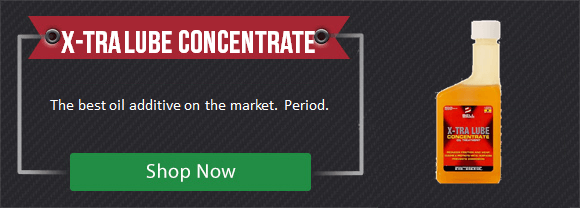
Bell Performance developed X-tra Lube Concentrate around a patented calcite-based technology designed to reinforce lubricating protection and reduce metal-to-metal contact. It also supplements acid-neutralizing capacity and helps control deposits. Its active chemistry is designed to remain stably dispersed in the lubricant rather than settling out and accumulating in the oil system.
Bell has also evaluated X-tra Lube Concentrate alongside other aftermarket oil treatments using standardized wear testing. Those results provide one piece of evidence for evaluating its anti-wear performance rather than relying solely on marketing claims.
What should owners of high-mileage and classic engines know?
High-mileage and classic engines deserve a little more attention because their lubrication requirements may not be identical to those of a modern passenger car.
Many older engines use flat-tappet valvetrains, where the contact between the cam lobe and lifter places significant demands on anti-wear chemistry. ZDDP has historically played an important role in protecting those surfaces.
Modern passenger-car motor oils are formulated around current engine designs, emissions systems, fuel-economy requirements, and oil specifications. Phosphorus levels in certain modern oil categories are controlled in part because excessive phosphorus can affect catalytic-converter durability.
That does not mean every classic engine needs a bottle of extra ZDDP.
The correct lubricant depends on the engine design, valvetrain, spring pressures, modifications, operating conditions, and recommendations of the engine or component manufacturer. Classic and performance engines with demanding flat-tappet valvetrains may benefit from an oil specifically formulated for those applications or from appropriate supplemental anti-wear protection.
High mileage creates a different set of considerations. Worn rings can increase blow-by, worn components can increase clearances, seals can harden, and oil consumption may increase. Those conditions can place additional demands on the lubricant, but they should not all be treated as the same problem.
Supplemental anti-wear and acid-neutralizing protection can make sense in a sound high-mileage engine that you are trying to preserve. It will not restore worn rings, rebuild bearings, or repair a failed seal.
And don't automatically respond to oil consumption by pouring in a much heavier oil. Use a viscosity grade appropriate for the engine and its operating conditions, following the manufacturer's guidance where applicable.
One final caution applies to motorcycles. Many motorcycles use the same lubricant for the engine, transmission, and wet clutch. Friction-modifying chemistry that is acceptable in an automotive engine can interfere with wet-clutch operation. Bell Performance does not recommend X-tra Lube Concentrate for motorcycle wet-clutch applications or for automatic transmission fluid.
When is an engine oil additive a waste of money?
An engine oil additive is a waste of money when it's asked to do a job oil can't do: stand in for an overdue oil change, fix worn bearings or a failing pump, or deliver a big jump in fuel economy. A newer engine on the correct oil, changed on schedule and driven gently, gets limited added benefit.
Be skeptical of the mileage pitch in particular. A clean, healthy oil supply lets an engine run the way it was designed to, and that is the honest ceiling on fuel economy claims for oil treatments. If a product's main selling point is miles per gallon, treat it as a warning sign; it's the kind of claim the FTC has pursued.
No bottle makes up for skipped maintenance. Change the oil on your manual's schedule, run the grade it calls for, and treat any additive as extra protection on top of that routine.
How much X-tra Lube Concentrate goes in each oil change?
X-tra Lube Concentrate goes in at 2 oz per oil change for engines holding 5 to 6 quarts of oil, mixed into the final quart or added directly to the engine. Larger systems take 1 part X-tra Lube Concentrate to 80 parts oil. One 8 oz bottle treats three to four oil changes, depending on oil capacity.
Application
Product
Treat rate
Treats up to
Cars, SUVs, and light trucks (5 to 6 qt of oil)
X-tra Lube Concentrate
2 oz per oil change
One 8 oz bottle treats 3 to 4 oil changes
Diesel pickups and larger engine sumps
X-tra Lube Concentrate
1 part to 80 parts oil (about 6 oz in a 15 qt sump)
Scales with sump size
Agricultural, industrial, and heavy equipment lube systems
X-tra Lube Concentrate
1 part to 80 parts oil (1:80)
Scales with system volume
Motorcycles with wet clutches; automatic transmission fluid
X-tra Lube Concentrate
Not recommended
Not applicable
Frequently asked questions about engine oil additives
Do engine oil additives really work?
Some do, when they are used for the right purpose.
Aftermarket oil additives can supplement anti-wear protection, modify friction, condition seals, change viscosity, clean deposits, or perform other specific functions depending on their chemistry. But the category also has a long history of exaggerated performance claims.
A credible product should tell you what it is designed to do, specify an appropriate treatment rate, be compatible with its intended application, and provide meaningful technical evidence for its claims. Standardized laboratory testing such as ASTM D4172 can provide useful evidence of anti-wear performance, although no single laboratory test proves how a product will perform in every engine.
Is an oil additive better than switching to synthetic oil?
They do different things.
Synthetic motor oil uses base stocks selected and formulated to provide characteristics such as strong oxidation resistance, low-temperature performance, and stability across a wide operating-temperature range. An aftermarket additive supplements the chemistry of the finished motor oil.
If your owner's manual requires or recommends a particular oil specification, viscosity grade, or synthetic oil, start there. An aftermarket additive should never be treated as a substitute for using the correct motor oil.
X-tra Lube Concentrate is intended to supplement compatible engine oil, whether conventional or synthetic, rather than replace the protection the oil itself is designed to provide.
Can you put too much oil additive in your engine?
Yes.
Motor oil is a carefully formulated mixture of base oils and additives, and more additive is not automatically better. Overtreating can alter the balance of the finished lubricant and, depending on the product, can affect properties such as viscosity or additive performance.
Always follow the product's specified treatment rate rather than assuming additional product provides additional protection.
For X-tra Lube Concentrate, use 2 ounces per oil change in engines holding 5 to 6 quarts of oil, or 1 part X-tra Lube Concentrate to 80 parts oil in larger systems.
Will an oil additive fix low oil pressure?
No—not when the low pressure is caused by a mechanical or maintenance problem.
Low oil pressure can result from low oil level, worn bearings, a worn oil pump, a restricted pickup, excessive fuel dilution, incorrect oil viscosity, or other problems. Determine the cause rather than trying to raise the pressure by adding something to the crankcase.
If the dashboard indication is questionable, verify actual oil pressure using the appropriate diagnostic procedure.
An anti-wear additive may provide supplemental protection in an older or heavily loaded engine, but it cannot rebuild worn bearings or repair a failing oil pump.
How often should you add an engine oil additive?
Follow the directions for the specific product.
If you have chosen to use X-tra Lube Concentrate as part of your lubrication program, add the recommended amount with each oil change because the previous treatment leaves the engine when the used oil is drained.
For engines holding 5 to 6 quarts of oil, use 2 ounces of X-tra Lube Concentrate per oil change. Larger systems use 1 part X-tra Lube Concentrate to 80 parts oil.
That does not mean every engine needs an aftermarket additive at every oil change. A newer engine operating normally on the correct oil may already have all the protection it requires.
Can you use an engine oil additive in a diesel engine?
Yes, provided the additive is intended for diesel-engine crankcase use and is compatible with the oil and application.
Diesel engines—particularly those used for towing, agriculture, construction, and other severe-duty applications—can place substantial thermal and mechanical demands on their lubricants. Diesel engine oils are already formulated with additive packages designed for those conditions, so any supplemental product should work with rather than replace the correct engine oil.
X-tra Lube Concentrate is formulated for gasoline and diesel engines in automotive, agricultural, industrial, and heavy-equipment applications. Larger oil systems use it at 1 part X-tra Lube Concentrate to 80 parts oil.
Can you use an engine oil additive in a motorcycle?
Only if the product is appropriate for the motorcycle's lubrication system.
Many motorcycles use one lubricant for the engine, transmission, and wet clutch. Certain friction-modifying chemistries can change the friction characteristics required for proper wet-clutch operation.
Bell Performance does not recommend X-tra Lube Concentrate for motorcycle wet-clutch applications. It is also not recommended for use in automatic transmission fluid.
For a motorcycle with a wet clutch, use an oil carrying the specifications required by the motorcycle manufacturer.
Give a hard-working engine more protection
The first rule of engine protection is still the simplest one: use the correct motor oil and change it when you should.
An aftermarket oil additive belongs on top of that foundation, not in place of it.
For engines that tow, haul, work off-road, operate under severe conditions, have accumulated significant mileage, or simply need additional anti-wear protection, X-tra Lube Concentrate is formulated to supplement the protection already provided by the engine oil. Its calcite-based technology helps reinforce lubricating protection, reduce metal-to-metal contact, supplement acid-neutralizing capacity, and control deposits between oil changes.



 Erik Bjornstad

 Erik Bjornstad : May 7 2026


Leave a Comment
Have a question or something to add? Share your thoughts below.