


Diesel Fuel Problems In Storage
The efforts to clean up diesel fuel to lessen its impact on the environment have given us fuel that is both markedly cleaner than ever before but also much more prone to costly problems, especially when it is stored in storage tanks. A large portion of the blame comes from the refinery processes used to remove most of the fuel sulfur. This ultra-low sulfur diesel (ULSD) fuel is the only kind of diesel fuel you would have been able to get since about 2010.
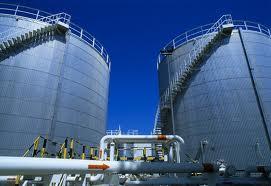
And it’s got a host of problems that must be reckoned with – markedly shorter storage life than fuels from even 10-20 years ago, and a virtual absence of any ability to resist microbial activity in the fuel. This latter point is important, because it amplifies the traditional water problems that diesel has had in storage. In today’s ULSD fuels, the water accumulation that is universal to storage tanks of all shapes and sizes now mean microbial growth and destruction of fuel quality to extents never really seen in years past.
Diesel Fuel Stability Issues
Given enough time, any petroleum product – gasoline, diesel, fuel oil, natural gas – will react with things in the environment they are exposed to, like water, metals and light.
Light really just acts as a catalyst to accelerate oxidation chemical reactions – where oxygen reacts with the fuel molecules and causes them to react with other molecules – fuel or not - leading to the formation of polymers that react with other polymers in chain reactions. This is why diesel fuel poured into a glass jar and left exposed to sunlight will still darken over time – the oxidation reactions cause the color change.
Exposure to water or air can start or speed up fuel oxidation. Both water and air are excellent oxygen donators, and oxygen is the primary culprit in oxidation. Exposure to certain kind of metals (like copper) as the fuel passes through a fuel storage and delivery system – these can also start and speed up oxidation, although these kind of metals merely act like catalysts and oxygen would still need to come from another source (not usually an issue in the typical fuel storage system or tank).
Lastly, if the tank has a microbial contamination (more on that later), these acids given off by the microbial biological processes attack fuel and hasten its breakdown.
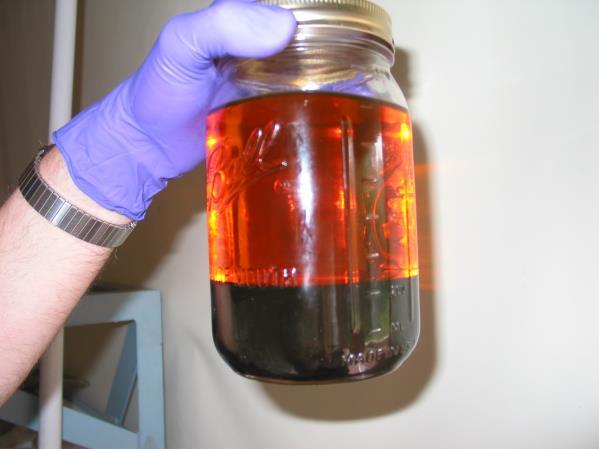
Over time, the fuel starts to separate and break apart, with these “heavy end” molecules agglomerating together and sinking to the bottom of the mixture (because they are the heavier molecules). Fuel which has oxidized and stratified like this loses its ability to combust at an optimal level. And this means the fuel isn’t going to provide everything it’s designed to, if it can even support engine operation at all.
This is an especially critical problem for emergency management and generator operators, when their stored fuel may not be of sufficient quality to support a critical generator running at even 50% load. What’s going to happen when they need full load from that generator in an emergency?
The whole issue of stabilization and storage is a bigger issue for diesel than for gasoline because it is much more common to store diesel fuel for longer periods of time. Fuel suppliers and industrial customers who store fuel and need to keep it fresh will use an oxidation inhibitor – a fuel stabilizer – to interfere with these harmful reactions and keep the fuel fresh. Consumers who store fuel (such as the boat owner who leaves fuel in his tank over the boat’s winterization period) are advised to do the same.
Microbial Contamination
Storage of diesel fuel, especially ultra-low sulfur diesel and diesel fuel with small amount of biodiesel, for long periods of time also makes them more susceptible to contamination by microorganisms like bacteria and fungus. Despite most best efforts, water inevitably collects at the bottom of the tank. This provides the necessary environment for microbes to grow and flourish in fuel – they live at the interface with the water and fuel, and draw their necessary elements and nutrients from both the fuel and water phases. Pretty soon you’ve got a microbial infestation that produces slimy “mats” which float on top of the fuel. The microbes multiply, excreting acids from their biological processes which both corrode the fuel tank and accelerate the breakdown of the diesel fuel, leaving you with a tank of nasty, poor quality fuel.
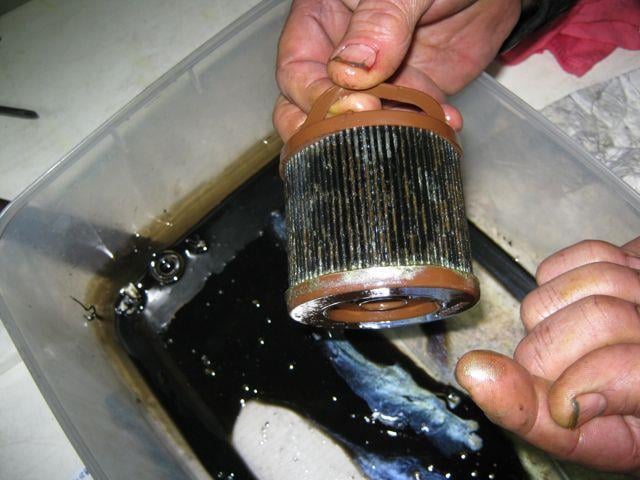
Today’s ULSD fuels have virtually no natural resistance to microbial growth because of the removal of the fuel sulfur. Sulfur, historically, has functioned to retard microbial growth – they don’t like to be around it. While ULSD fuels are much better for the environment, they are extremely prone to microbial growth that may happen very quickly. It is not uncommon to start with a completely clean and sterile fuel storage tank and see evidence of fuel microbial activity within 1-2 months.
As you can guess, microbial contaminations are most common in situations where the fuel is stored for long periods of time, and also more common in marine situations where the fuel tank is around water. How do you know if you’ve got an infested tank? You’ll probably notice rough running and poor performance with your vehicle or boat. Fuel filters will clog more often and (if you have a storage tank you can see the fuel in), you should be able to see slime floating on top of the fuel (along with foul sulfurous odors). All of these are strong indicators that the diesel fuel tank has a microbial problem.
There are a number of fuel additive products that will claim to eliminate microbial infestations from fuel simply by controlling water. This is where the devil is in the details. Once a tank has an active infestation, simply removing the water alone will not disinfect the tank. You could put fresh fuel in the tank, and over time the microbes would come back in full force. To kill an active infestation, you need to use a Biocide product, which acts to actively kill and destroy the bacteria and fungi. Removing water alone will not kill an infestation if it does take root in your fuel. For maximum effectiveness, biocides also need to be added as part of a preventive maintenance protocol where they can be actively circulated into the fuel.
Injector Deposits
All diesel engines use some form of fuel injection. Most small diesel engines used to use a system called indirect injection (ID1) while larger engines use direct injection (DI). And common rail diesel engines are the dominant technology of today. Most modern passenger car diesels have switched to DI for fuel economy reasons. IDI tends to be smoother and quieter, while DI is more fuel efficient. Whether direct, indirect or common rail, diesel injection technology is light years ahead of what it used to be.
The fuel injector sprays the diesel fuel into hot, compressed air, and the mixture auto-ignites. Efficient metering, atomization and fuel-air mixing are key requirements for good combustion and especially important for low levels of exhaust emissions. Common rail injection systems go several steps further by using a rail-like apparatus to pressurize the injectors and allow the ability to execute multiple injection events in a single stroke, something that previous diesel engine designs found impossible to do.


Spray Patterns of Clogged vs Clear Injectors
Modern diesel injectors are designed to exacting standards and form an integral part of the process for optimizing fuel combustion. Their flow characteristics are set to allow a small pilot injection of fuel to initiate combustion, and then inject progressively more fuel into the burning mixture. Such an approach provides a low rate of pressure rise and smoother combustion.
Mechanism of Formation of Injector Deposits in Diesel Engines
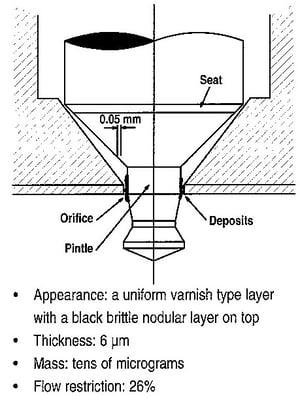
Both gasoline and diesel fuels consist of components that boil over a wide temperature range (the diesel range is higher than the gasoline range). When the engine is switched off, fuel remaining in or near the pintle tips mixes together with any remnants of un-burnt engine oil and is subjected to high heat soak temperatures. Such high temperatures lead to the formation of free radical species, and then to a combination of auto-oxidation, chemical rearrangement and degradation of the remaining fuel – and deposits form within the injector.
Diesel fuel does not have the same injector deposit control specifications that gasoline does. Therefore, it is beneficial for the consumer to use an aftermarket detergent fuel treatment to remove these deposits and prevent their formation.
Effect of Deposits on Diesel Injectors
Clean fuel injectors are critical for efficient diesel engine operation. A well dispersed spray pattern maximizes fuel-air mixing, while good atomization ensures rapid, efficient combustion. All diesel fuels, but especially those containing products from refinery conversion processes, have a tendency form a small amount of coke in the annulus of the injector. This coke is believed to be caused by the thermal decomposition of unstable compounds in the fuel. It is such a common problem that injectors are designed to tolerate a certain level of coke. However, many of today's diesel fuels give excessive levels of injector coking, disrupting the fuel spray pattern and degrading atomization.
Higher emissions, noisier engines and a decrease in fuel economy are the result, as shown by controlled vehicle studies. These studies show up to a 15% decrease in city economy and 5% decrease in highway (according to EPA test protocols). For the FTP driving protocol, the results are a 2-11% reduction in fuel economy over the FTP driving protocol, depending on the level of plugging (8-30%).
Another definitive study used fouled injectors collected from two different types of vehicles in the field to show the changes in performance based on sets of injectors with varied average levels of fouling and ranges of fouling. Under the worst conditions of 30% average flow restriction, with a corresponding range of 30% between the best and worst injectors, the author showed: a 700% increase in hydrocarbon (HC) emissions
In high-fouling injectors, research shows the engine compensates and can cause some cylinders to receive too much fuel and some to receive too little (rich and lean). Once cleaned, a 10.5% improvement results in 40-100 kph acceleration times and a 15.8% improvement in 80-100 kph times. This is confirmed in other parallel vehicle studies, where clogged injectors show a reduction in engine power up to 22% and a 1.3 – 2.8 second penalty in acceleration tests.
Intake And Port Valve Deposits
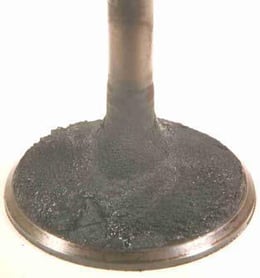
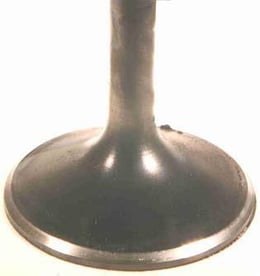
Example showing the effect of detergent additives on inlet valve deposits compared to unadditized fuel.
Poor fuel combustion and stratified diesel fuel which has broken down in storage (because of water buildup, microbial contamination or oxidative breakdown) can lead to deposit formations building up on the valves in the engine. Problems with power loss, decreased fuel economy, startability, driveability demerits, decreased power (increased acceleration times) and increased emissions can all result from this.
Valve deposits can also be a result from a mixture of environmental contaminants and also from mechanical issues in older engines, where engine blow-by (from a worn PCV valve), cylinder blowback (from insufficient ring seal and wear), exhaust gas recirculation (in large transportation truck engines) and lubricating oil, all of those can combine to build up on the valve stems and underside of the valve, forming deposits.
Typically, the biggest ill-effect from these deposits comes when they get large enough to physically block the manifold passage and restrict air and fuel flow into the cylinder. This used to be quite common when carburetors were widespread, and would result in poor acceleration, power, fuel economy and raised emissions. But even low levels of deposit accumulation can affect mileage and emissions, since the deposit can act as a sponge, absorbing fuel into the pores of the deposit, then releasing the fuel through evaporation or desorption (release of absorbed fuel). This disrupts the flow of fuel at the proper timing interval into the cylinder and reduces droplet evaporation efficiency, thus creating an imbalance in the fuel/air mixture into the cylinder. And this means the engine isn’t functioning or combusting fuel optimally.
So the typical issues in modern, port fuel-injected engines that have valve deposits are poor driveability (particularly upon cold start-up and during warm-up conditions) and poor emissions performance. Vehicular studies using standard driving procedures like the CRC show a linear correlation between the level of valve deposits and “driveability demerits”, which are an index related to how well or poorly the vehicles performance on “driveability”. It can be clearly shown that valve deposit buildup affects the vehicle’s driving performance and it gets worse the more deposits that build up.
Cold Weather Performance
Cold weather performance is a big issue for diesel truckers who live and work in cold northern climates, as well as for emergency backup systems that rely on stored diesel fuel to perform in emergencies. Diesel fuel contains complex paraffin wax molecules as part of its composition that serve to contribute to the energy value of the fuel. But when the fuel gets cold, these waxes will come out of solution, making the fuel cloudy. Once out of solution, they stick together to form larger and larger crystals of wax that gel the fuel and plug the fuel filter, shutting down operation.

In these cold climates, a cold flow fuel treatment is an essential tool. These kind of products keep the fuel from gelling by keeping the wax crystals in suspension from sticking together. The crystals stay small enough that they can pass through the fuel filter without a problem, where they get burned off in the combustion chamber with the rest of the fuel.
The previously-mentioned common rail diesel engines have a greater need for cold flow treatment in their fuel than previous engine designs, because the fuel filters catch smaller particles than before. This means these common rail engines will experience service interruptions from fuel gelling at higher temperatures than previously expected.